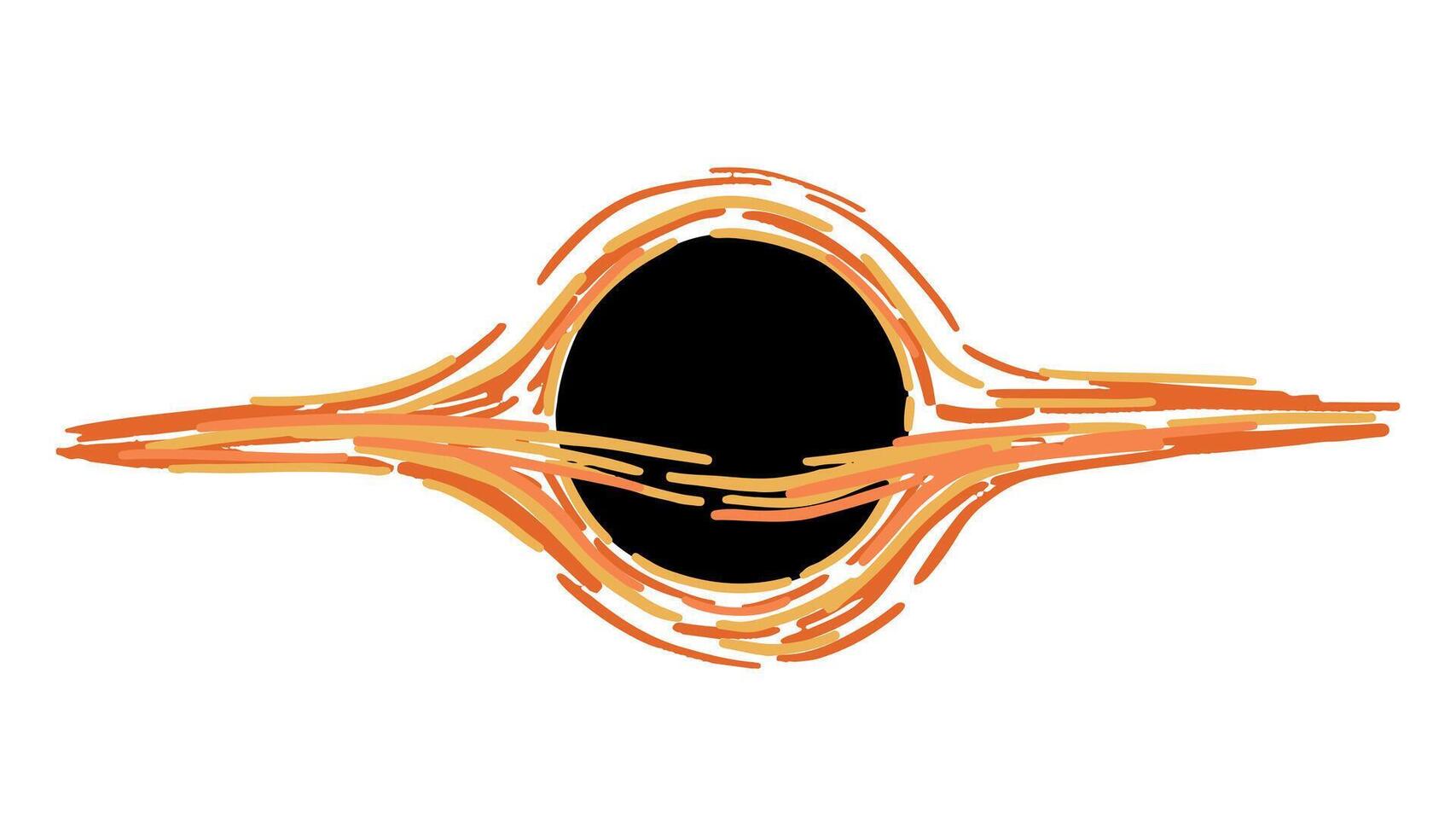
Schwarzschild Radius
Schwarzschild Lab
NEW HORIZONS MISSION CONTROL • GENERAL RELATIVITY MODULE 2026
Event Horizon Boundary
The Point of No Return. The Schwarzschild radius defines the radius of the event horizon surrounding a non-rotating black hole, marking the threshold where escape velocity equals the speed of light.
Gravitational Confinement: Anything passing inward across this boundary—including light and radiation—is inexorably trapped by the central gravitational collapse.
- 🕳️ Event horizon boundary enclosing mass.
- ⚡ Escape velocity exceeds light speed.
The Mathematical Formula
Core Equation. The exact mathematical expression derived from general relativity is written as rs = 2GM / c2, where rs is the Schwarzschild radius.
Proportional Scaling: Because gravitational constant (G) and speed of light (c) are universal constants, the horizon radius grows linearly and directly in proportion to the mass (M) of the object.
- 📐 Formula: rs = 2GM / c2
- ⚖️ Radius scales linearly with mass.
Mass and Scale
Stellar Proportions. Any mass can theoretically become a black hole if compressed within its respective Schwarzschild radius. For instance, compressing Earth to a radius of about 9 millimeters creates a black hole.
Solar Mass Reference: A black hole possessing one solar mass (1 M⊙) features a Schwarzschild radius of approximately 2.95 kilometers.
- 🌍 Earth compressed down to roughly 9 mm.
- ☀️ One solar mass yields ~2.95 km radius.
Historical Solution
General Relativity Breakthrough. In 1915, German physicist Karl Schwarzschild derived the first exact solution to Albert Einstein's field equations of general relativity while serving on the Russian front during World War I.
Spacetime Geometry: His metric described the gravitational field outside a static, spherically symmetric mass, predicting the existence of event horizons long before observational astronomy confirmed them.
- 📜 Derived in 1915 from Einstein field equations.
- ⏳ First exact metric for spherical mass fields.
Escape Velocity
Newtonian Derivation. Interestingly, setting the classical Newtonian escape velocity equal to the speed of light yields the exact same formula for the radius.
Light Confinement: Setting v = c in the formula v = √(2GM / r) and solving for r yields the Schwarzschild radius equation, demonstrating why light cannot escape.
- 🚀 Newtonian velocity equals light speed (c).
- 💡 Explains light entrapment intuitively.
Time Dilation
Extreme Chronology Shifts. As an object approaches the event horizon, gravitational time dilation approaches infinity relative to a distant observer.
Freezing Clocks: To an outside observer, an infalling clock appears to slow down and freeze completely at the event horizon, highlighting the profound distortions of spacetime near rs.
- ⏱️ Time dilation approaches infinity at horizon.
- 🌌 Infalling clocks appear frozen to outsiders.
Tidal Forces
Extreme Gradient Stresses. Tidal forces near a black hole depend heavily on its mass. For stellar-mass black holes, tidal forces at the event horizon are ferocious, tearing objects apart.
Supermassive Exceptions: Conversely, supermassive black holes feature enormous event horizons with weak gravitational gradients at the boundary, allowing travelers to cross rs safely before experiencing crushing tidal forces near the singularity.
- 🍝 Extreme stretching known as spaghettification.
- 🌀 Gentler horizon entry on supermassive black holes.
Supermassive Giants
Galactic Center Colossi. At the hearts of most galaxies lie supermassive black holes containing millions or billions of solar masses.
Immense Horizons: Sagittarius A*, the supermassive black hole at our Milky Way's center, has a mass of about 4 million solar masses, yielding a Schwarzschild radius of roughly 12 million kilometers (about 0.08 AU).
- 🌌 Found at the core of major galaxies.
- ⭐ Sagittarius A* radius spans ~12 million km.
Rotating Black Holes
The Kerr Metric. Real astrophysical black holes spin. Roy Kerr solved Einstein's equations for rotating masses in 1963, introducing frame-dragging and a flattened event horizon structure.
The Ergosphere: Rotating black holes feature an outer region called the ergosphere where spacetime itself is dragged along with the black hole's rotation speed, allowing energy extraction via the Penrose process.
- 💫 Kerr metric accounts for angular momentum.
- 🌐 Features an ergosphere with frame-dragging.
Event Horizon Telescope
Direct Shadow Imaging. The Event Horizon Telescope (EHT) collaboration linked radio observatories worldwide to capture the first direct optical shadows of supermassive black holes in M87* and Sagittarius A*.
The Shadow Contour: The dark shadow observed is roughly 2.5 times larger than the actual Schwarzschild radius due to strong gravitational lensing bending light paths around the event horizon.
- 🔭 Global VLBI network imaging black hole shadows.
- 🌟 Gravitational lensing magnifies shadow profile.

Black Hole Event Horizon FAQs
Exploring the physics of the Schwarzschild radius, the point of no return, and the boundaries of spacetime
The event horizon is the boundary surrounding a black hole beyond which nothing—not even light or electromagnetic radiation—can escape the immense gravitational pull.
The Schwarzschild radius is the radius defining the event horizon of a non-rotating black hole, representing the precise distance from the center where escape velocity equals the speed of light.
The formula is rs = (2GM) / c2, where G is the gravitational constant, M is the mass of the object, and c is the speed of light in a vacuum.
Yes! Theoretically, any mass can form a black hole if compressed within its respective Schwarzschild radius (for example, compressing Earth down to the size of a marble).
According to Einstein's theory of general relativity, time dilation becomes extreme near the event horizon, meaning time slows down drastically for an outside observer viewing falling matter.
No, the event horizon is not a solid boundary or barrier; it is purely a mathematical threshold in spacetime where the gravitational escape velocity exceeds the speed of light.
German physicist and astronomer Karl Schwarzschild calculated this exact solution to Einstein's field equations of general relativity in 1915 while serving on the Russian front.
Inside the event horizon lies the gravitational singularity, a point where mass is crushed to infinite density and our current laws of physics break down entirely.
Yes, the size of the event horizon scales directly with mass. When a black hole consumes matter, gas, or merges with another black hole, its Schwarzschild radius grows larger.
Key search phrases include: black hole event horizon, Schwarzschild radius formula rs, general relativity spacetime boundary, and gravitational singularity physics.


