
Engine Displacement (CC) Calculator
ENGINE DISPLACEMENT LAB
Advanced Multidimensional Volumetric Solver Engine & Reciprocating Swept Space Analyzer
NEW HORIZONS MISSION CONTROL • AUTOMOTIVE VOLUMETRIC METRICS 2026
Bore Diameter
Cylinder Bore (d). The inner diameter of an engine cylinder wall. Because area scales quadratically with diameter, precision calibration here is paramount for accurate cubic capacity mapping.
Measurement: Typically tracked in millimeters (mm) or inches (in) before volume conversions.
- 📐 Dimension: Perpendicular surface width cross-section.
- 🔧 Tolerance: Micro-machined wall clearance metrics.
- ⚙️ Impact: Dictates the structural volume limits of the engine block.
Stroke Length
Piston Travel (s). The linear distance traveled by the piston inside the block between Top Dead Center (TDC) and Bottom Dead Center (BDC).
Rule: Longer stroke lengths alter crankshaft leverage profiles, elevating torque output indicators at lower operational limits.
- ↕️ Travel: Linear displacement depth plane.
- 🔄 Crank: Directly proportional to throw radiuses.
- ⚖️ Ratio: Determines under-square or over-square configuration.
Cylinder Multiplier
Cylinder Array (N). The total count of firing chambers active within the powertrain infrastructure.
Logic: Total displacement scales lineally by multiplying single-chamber volume array indexes across the total operational unit metrics.
- 🔢 Count: Total geometric expansion scaling factor.
- 🏎️ Layout: Inline, V-configuration, or boxer setup structures.
- 🔗 Sync: Direct integration with multi-cylinder math fields.
Displacement Law
Displacement Matrix. Calculating the displacement total via cylindrical matrix rules. The formula maps radius squared against stroke and cylinder numbers.
Equation: CC = π * (Bore / 2)² * Stroke * Cylinders / 1000
- 📊 π Factor: Standard circular area multiplier constants.
- 🧪 Divisor: 1,000 index shifting from mm³ to cubic centimeters (cc).
- 🔋 Yield: Defines total swept capacity bounds.
Unit Scale
Volume Translation. Shifting engine capacity metrics cleanly between cubic centimeters ($cc$), Liters ($L$), and cubic inches ($ci$) for global platform profiles.
Conversion Ratios: 1,000 cc = 1.0 Liter | 1 cc = 0.0610237 cubic inches.
- 🔄 Metric Shift: Decimal realignments for Liter grouping.
- 🇺🇸 Imperial: Cubic inch mappings for classic architectures.
- 📈 Precision: Floating-point protection inside code logic grids.
Compression Sync
Compression Ratio (CR). The dynamic ratio linking total cylinder volume at BDC to the residual clearance space volume remaining at TDC.
Equation: CR = (Swept Volume + Clearance Volume) / Clearance Volume
- 🔥 Clearance: Combustion chamber head volume limits.
- 💥 Pressure: Thermal efficiency scaling potentials.
- ⚡ Link: Swept capacity maps this layer entirely.
Chamber Geometry
Proportional Balance. Comparing Bore against Stroke maps engine optimization types across square, oversquare (short-stroke), or undersquare (long-stroke) metrics.
Performance Index: Oversquare structures minimize friction, unlocking rapid top-tier RPM scaling.
- 🟩 Square: Perfect 1:1 footprint ratio profiles.
- 🚀 Oversquare: Wide bore, short stroke for high RPM arrays.
- 🚜 Undersquare: Long stroke dominance maximizing torque.
Volumetric Return
Volumetric Efficiency (VE). Total cubic volume determines potential airflow limits. Real power output profiles rest heavily on this baseline space metric.
Logic: Bigger $cc$ displacement metrics draw increased oxygen arrays, scaling overall potential fuel burn yields.
- 🌪️ Airflow: Total structural breathing capability bounds.
- 🐎 Horsepower: Directly linked to calculating capacity sizes.
- 🌀 Induction: Natural aspiration vs. forced turbo charging.
Crank Throw Kinematics
Crank Throw Radius (r). The offset distance of the crankshaft journals. This mechanism directly regulates stroke volume output values.
Kinematics Rule: Crank Throw Radius is exactly equal to exactly half of the total piston stroke distance ($\text{Stroke} = 2 \times r$).
- 🔄 Leverage: Defines internal torque arm distance variables.
- 🏋️ Stress: Alters rod angularity and structural piston acceleration profiles.
- ⚙️ Math: Essential coordinate mapping for calculation engines.
Engine Yield
The Displacement Engine. The terminal layout system evaluating total internal space matrices. It transforms raw dimensions straight into standard vehicle capacity definitions.
Execution: Audit Bore, Sync Stroke, Multiply Chambers, Render CC.
- 1️⃣ Isolate: Acquire exact cross-cylinder diameter values.
- 2️⃣ Integrate: Track vertical stroke distance intervals.
- 3️⃣ Compute: Render final cubic centimeters ($cc$) cleanly across the dashboard.
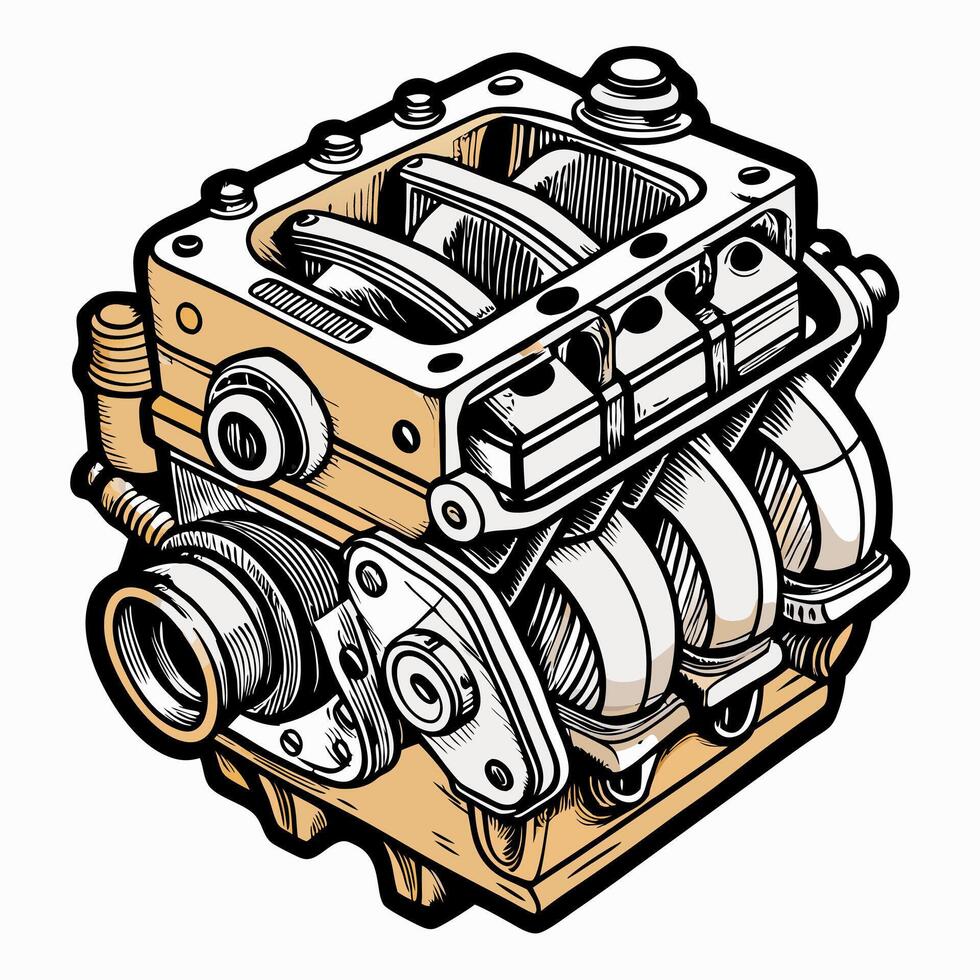
Master Engine Displacement
Understand the science behind your engine. Learn how to calculate CC and Liters with precision, and explore how bore, stroke, and cylinder count define your vehicle's true power.
READ ENGINE BLOGS